
Friday, April 28, 2006
Eggs in the Nest
Our Great Tit has laid some eggs today. I've been recording 30 minute videos periodically to hopefully catch all the action, but it looks like these eggs were laid after my last clip today, but before I got home. Shortly after I saw this image on the camera the proud mother came back to settle down for the night, so I caught that on video at least.


Monday, April 24, 2006
Nestbox Success
We got back from our holiday to find that a Great Tit has started to build a nest in our nestbox with the camera fitted. I weas very excited to see her sleeping in there last night. I checked again this morning and she had gone out, revealing that there are no eggs in the nest yet. I've set up the computer to record some video at various times during the day in the hope of catching the action on video.

Nesting Great Tit

Nesting Great Tit
Friday, April 14, 2006
Siskin Sighting
We spotted a new species for our garden this week, when a pair of Siskins came to eat at our Nyjer feeder. The pair of Goldfinches attracted to this feeder are turning up every day too.
Friday, April 07, 2006
Pond Liner Laid
Laid the pond liner in a hurry before going away, so that it can start filling up with rain water. I'll have to finish off the landscaping after our holiday, but at least the pond water can start developing into a habitat.

I had a little help from the cat!

I had a little help from the cat!
Sunday, April 02, 2006
Blackbird Nesting
Our resident Blackbirds are nesting in the hedge again this year. This is a relief because I cut the hedge back during the Winter, and thought I may have openned it up a bit much for them. (This prevented them from nesting a couple of years back). In fact the nest is more visible this year, which allowed me to get a clear view of the mother sat on it.

Blackbird on her nest

Blackbird on her nest
Wednesday, March 29, 2006
Frogspawn Success
After the recent operation to drain the pond to prevent more frogs dying in the foul water, I deliberately put some rain water from a water butt into the pond just in case any more frogs turned up to spawn in the usual place. This turned out to have been a good move, because yesterday the pond contained several balls of frogspawn. Meanwhile none of the pairs of frogs I rescued and relocated to the other pond have spawned there. Most of them appear to have moved on from that pond, and I suspect they returned to this pond to spawn when we had a lot of rain the other day. It looks like the instinct to return to the same spawning location year after year drives them even after they have paired up in a pond. They have spent over a week in pairs since I relocated them, but appear to have made the trip back up the garden to the original pond before spawning.


Thursday, March 23, 2006
Frog Tragedy in the Old Pond
To my horror I discovered last night that our the old pond had turned into a deathtrap for frogs. It appears that a lot of leaves sunk into the pond over the Autumn and Winter, making the water foul. I went to check for frogspawn and noticed a dead frog. Disturbing the water revealed that the whole pond was foul, and many more dead frogs were found while trying to clean out the dead leaves hiding below the water surface. Some of these were clearly only recently deceased. One was full of spawn. I think they had suffocated due to lack of oxygen in the water. With more frogs turning up for the spawning season, I had to take drastic action and decided to empty the pond. In total I found about 15 dead frogs, and rescued 5 mating pairs who thankfully appeared healthy. I relocated the healthy pairs to the smaller water feature pond in another part of the garden. The frogs have not adopted this newer pond, presumably because they return to the pond of their birth to spawn. I decided to drain the old pond to prevent any more frogs drowning in it. Hopefully now the newer pond is a hotbed of mating action they will spawn there rather than heading back up the garden to the original one again.

This is the old pond, from which I cleaned out as much muck as possible and then added some fresh water from the rainwater butts in the garden in case more frogs return to spawn. You can see the frog escape ramp I have fitted so that they can get out again.

This is the old pond, from which I cleaned out as much muck as possible and then added some fresh water from the rainwater butts in the garden in case more frogs return to spawn. You can see the frog escape ramp I have fitted so that they can get out again.

The frogs seem happy enough in their new temporary home. I hope they will relocate back to the new pond once it is completed and fit to inhabit. I will probably move some frog spawn to the new pond when it is ready as the pond that these frogs are in at the moment is too small for them, and I want the offsping to return to the new pond to spawn in future years.
Wednesday, March 22, 2006
Work Starts on Wildlife Pond
Two productive days work in the garden with much help from my father-in-law has seen the basic shape of the long planned pond dug out. We have an old pond which was there when we moved into the house, but it fails in all the important criteria for a wildlife pond. A well designed pond for wildlife should feature the following:
- Shallow sides to allow easy access to wildlife
- Shallow water zones (<50cm depth)
- Deep water zone (>50cm depth, preferably 1 metre deep)
- A large enough overall volume to cope with Summer temperatures
Our old pond has vertical sides and a uniform depth of about 50cm. Too deep for frogspawn and not deep enough to stop the water getting too hot in Summer. The new pond is much larger and will have the required shallow and deep zones. Due to the gradual slope across the garden, we had to build up the down slope edge of the pond to make the edges level all round. This has the major advantages that we do not have to dig as deep a hole to get the desired 1 metre depth, and we can use all the spoil to build up the ground around the lower end of the pond. You can see the basic shape in the picture below. The old pond is located in the corner of the garden at the back of this picture. Eventually I hope to remodel the original pond and turn it into a header pond for a waterfall, flowing into the new pond.

Our garden is on the site of an old builders yard, and we were still digging through rubble at the bottom of the pond. Eventually we will use all the rubble we have dug out to raise the surrounding area back up to the new raised edge of the pond, resulting in a pond that is set into a level garden.
- Shallow sides to allow easy access to wildlife
- Shallow water zones (<50cm depth)
- Deep water zone (>50cm depth, preferably 1 metre deep)
- A large enough overall volume to cope with Summer temperatures
Our old pond has vertical sides and a uniform depth of about 50cm. Too deep for frogspawn and not deep enough to stop the water getting too hot in Summer. The new pond is much larger and will have the required shallow and deep zones. Due to the gradual slope across the garden, we had to build up the down slope edge of the pond to make the edges level all round. This has the major advantages that we do not have to dig as deep a hole to get the desired 1 metre depth, and we can use all the spoil to build up the ground around the lower end of the pond. You can see the basic shape in the picture below. The old pond is located in the corner of the garden at the back of this picture. Eventually I hope to remodel the original pond and turn it into a header pond for a waterfall, flowing into the new pond.
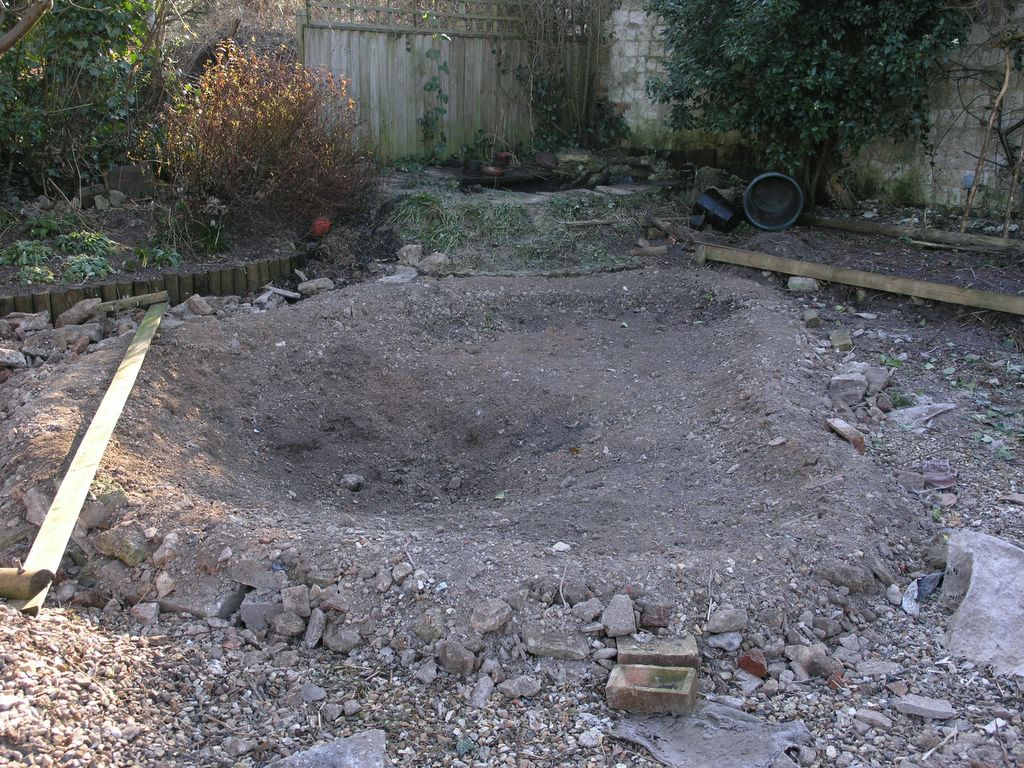
Our garden is on the site of an old builders yard, and we were still digging through rubble at the bottom of the pond. Eventually we will use all the rubble we have dug out to raise the surrounding area back up to the new raised edge of the pond, resulting in a pond that is set into a level garden.
Tuesday, February 21, 2006
First Recorded Nestbox Visitor
This weekend I was cleaning the nestbox containing the camera which I built last year, but which did not get used by any birds. The camera compartment built into the lid of the nestbox had become home to a nesting colony of spiders, whose nest webs were blocking the light from the LEDs. After cleaning it up enough to get the camera working, I was trying to determine why I could only get a black and white picture when this Great Tit appeared on the camera! After picking off all the spiders crawling around in the main nestbox compartment, it fluffed itself up and tucked it's head under it's wing and settled down for the night. Hopefully this is a sign that the box will be used for nesting this Spring.

First recorded nestbox visitor

First recorded nestbox visitor

Wednesday, January 04, 2006
New Birds Brighten Winter Gloom
After a brief covering of snow over Christmas, the garden returned to it's usual damp and gloomy Winter appearance. I managed to get out on a couple of days over the holiday period and do some much needed hedge trimming. The pyracantha was getting out of control but I had left it until now because the new 5 ft long spikes which had grown out of the top of the hedge were covered in berries, which the birds eat. Now all the berries have gone, so it got a haircut.
New Years day brought a very pleasant surprise. Not one, but two species of birds which we have not previously recorded in our weekly bird survey were spotted in the garden. A female blackcap was seen feeding on a fat ball, and then a crow came and perched in the walnut tree. We also spotted every other species we have previously recorded in the garden apart from the gold finch, jay, song thrush and wren! A bumper bird day and a great start to the year.
I cleaned and repaired the main seed feeder over the holiday, cleaned up the window feeder and refilled it with black sunflower seeds. I also made some more fat cakes (consisting of ground up peanuts in vegtable fat) to put in the small bird feeding cage. This cage prevents the larger birds (gangs of starlings mainly) from eating the lot in a day, ensuring there is a reliable supply of high energy food for the smaller birds though the Winter. I was given a nyger seed feeder for Chrismas too, but I have to sort out a suitable site for that as it is not squirrel proof, and they chew their way through anything they can despite the best efforts of our cat to eat them!
New Years day brought a very pleasant surprise. Not one, but two species of birds which we have not previously recorded in our weekly bird survey were spotted in the garden. A female blackcap was seen feeding on a fat ball, and then a crow came and perched in the walnut tree. We also spotted every other species we have previously recorded in the garden apart from the gold finch, jay, song thrush and wren! A bumper bird day and a great start to the year.
I cleaned and repaired the main seed feeder over the holiday, cleaned up the window feeder and refilled it with black sunflower seeds. I also made some more fat cakes (consisting of ground up peanuts in vegtable fat) to put in the small bird feeding cage. This cage prevents the larger birds (gangs of starlings mainly) from eating the lot in a day, ensuring there is a reliable supply of high energy food for the smaller birds though the Winter. I was given a nyger seed feeder for Chrismas too, but I have to sort out a suitable site for that as it is not squirrel proof, and they chew their way through anything they can despite the best efforts of our cat to eat them!
Thursday, November 03, 2005
Autumn Cleaning
Finally got out into the garden to clean up some of the Autumn mess. Mainly walnuts, which we have had a bumper crop of this year. It has been very wet, so most of them split open and are starting to germinate. Even so, I think we easily collected as many as previous years.
Swept up all the mess (those walnut fruits turn into a very slipery, slimey black mess) and raked them out of the lawn. Took advantage of the wet to wash the path clean of this gunge with the yard broom. Cleaned out all the gutters too. Now awaiting the walnut leaves to fall, which will no doubt happen in the next few weeks.
Swept up all the mess (those walnut fruits turn into a very slipery, slimey black mess) and raked them out of the lawn. Took advantage of the wet to wash the path clean of this gunge with the yard broom. Cleaned out all the gutters too. Now awaiting the walnut leaves to fall, which will no doubt happen in the next few weeks.
Wednesday, September 28, 2005
Garden Neglect
I have to confess the garden is in a bit of a state at the moment. It was all under control until we went away for a couple of weeks in August, but due to the wet weather while we were away, we returned to a bit of a jungle. We haven't had time to get out and sort it either. Now the evenings are getting dark, it looks like we will be digging out all the weeds once they die back over the Winter.
The walnuts have started to fall now, so the garden is pretty much going to look a mess until after the Autumn leaf fall is over. Even the birds appear to have almost deserted us, with the ample supplies of natural food in the countryside at this time of year. What we need is a good fall of snow to make it all look clean and tidy!
The main project for the Winter is to sort out the bird boxes so they are weathered in ready for next Spring.
The walnuts have started to fall now, so the garden is pretty much going to look a mess until after the Autumn leaf fall is over. Even the birds appear to have almost deserted us, with the ample supplies of natural food in the countryside at this time of year. What we need is a good fall of snow to make it all look clean and tidy!
The main project for the Winter is to sort out the bird boxes so they are weathered in ready for next Spring.
Sunday, June 26, 2005
Crocosmia Flower Buds
I took this picture because I loved the shape and rich colour of these buds on the crocosmia we planted last year. These plants have grown about 5 feet high from the 2 ft high plant we bought, and there are three seperate flower stalks forming. The flowers will be bright red when they open.

Crocosmia Flower Buds

Crocosmia Flower Buds
Blackbird Taking Mealworms
The pair of blackbirds who nested in our hedge have been busy feeding their young. They nag at us to bring out mealworms when we come into the garden, and will come and take them from the bird table while I am still stood there having just put them out. This picture is a frame taken from a video clip I took. The male blackbird has filled his beak to overflowing with mealworms, and is about to fly up the garden to feed them to the young.

Blackbird Taking Mealworms

Blackbird Taking Mealworms
Saturday, June 04, 2005
Clematis Flowering Much Better This Year
After 3 years, our clematis 'Nelly Moser' has flowered well for the first time. Previous years it has only managed to put out a couple of flowers. This year it is covered in them.

Clematis 'Nelly Moser'
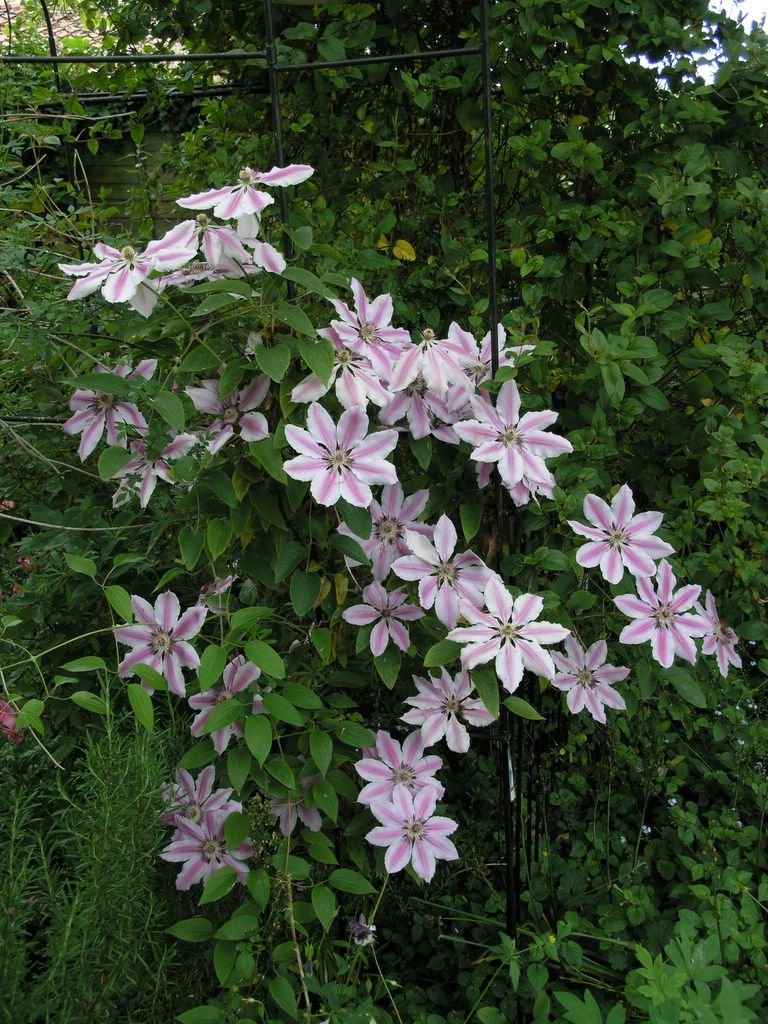
Clematis 'Nelly Moser'
Wednesday, May 18, 2005
Song Thrush Singing
This morning as I was nipping up the garden to open the greenhouse vent, I could hear a bird song that I did not recognise as one we regularly hear in the garden. Closer inspection of the large walnut tree with the binoculars identified the source as a Song Thrush. This is the first one I have seen in the garden for over a year. A welcome sight, and a new species to record in our garden bird survey data
Subscribe to:
Posts (Atom)

